How to Play
Roll. Land. Build, react, or trade. End turn. Repeat for 30 rounds.
1. The goal
Balance energy output and tokens against rising pollution across 4 eras and 30 rounds. Last empire standing, or the table co-operates into a renewable majority — both are wins. Cross the tipping point and everyone loses together.
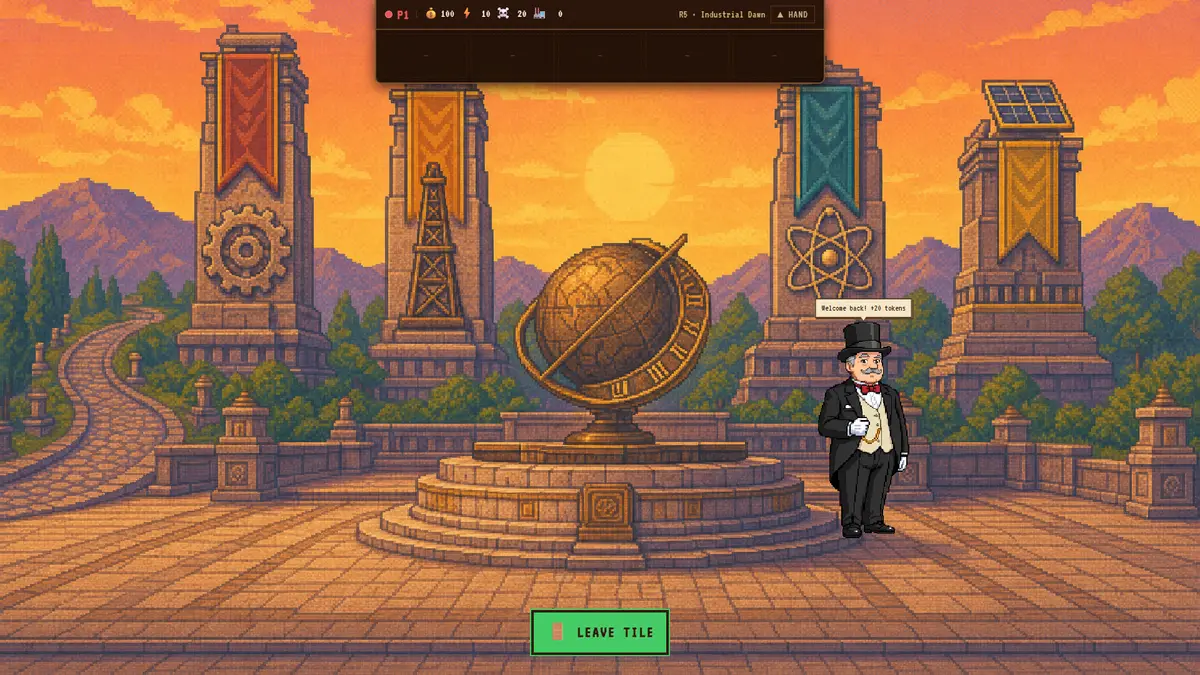
1a. Pick your archetype
Before the first roll, each of the four players picks one of four archetypes — Engineer, Scientist, Activist, or Politician. Each archetype carries a starting perk that shapes early-game strategy.

2. The turn
- Roll the dice. 1d6 (or 2d6 in later eras) determines how many tiles you advance.
- Walk to your tile. The board is a loop of mixed terrain, event, policy, trading, jail, and teleport tiles.
- Resolve the tile.
- Buildable terrain → build a facility, pay a toll if owned, or pass.
- Event / Policy tile → draw a card and resolve it.
- Trading tile → open a trade with one opponent.
- Jail → skip your build phase until you roll a double or pay your way out.
- Teleport → choose a destination.
- Use cards in hand — play Policy cards from your hand, react to incoming events with Mitigate cards.
- Leave Tile to end your turn. Hand control to the next seat.
Passing the Start tile decays any PassStart-mode auras you’re carrying — Steam Engine, Ocean Acidification, Drought. They tick down a stack on each loop.
3. Cards
79 cards total, split across three families (Event 38 / Policy 33 / Mitigate 8):
Crises and shocks that befall the drawer. Coal Mine Collapse, Drought, Oil Crisis 1973, Cyberattack, Worker Union Strikes, Paris Climate Agreement (draws a free Mitigate if you hold few fossil plants).
Active powers the drawer holds and plays from hand. Regulatory cards (Plastic Ban Enacted, Net Zero Movement, Carbon Capture System) and tech-flavoured policies (Solar R&D Grant, Nuclear Fusion, Smart Grid System, Direct Air Capture).
Reactive defenses held in hand to soften incoming shocks. Climate Adaptation Strategy, Disaster Relief Fund, UN Green Pact Support.
Every card has a printed effect, an educational fact from a real-world source, and where relevant, a build-cost modifier or aura that affects all subsequent builds until consumed.


Some Policies need a target. The drawer picks an opponent at decision time, with each per-seat panel showing the information needed to choose well.

4. Building facilities
When you land on buildable terrain you don’t already own, you may build one of the facilities legal in the current era. Each facility has a cost, an energy output, and a pollution contribution.
- Coal / Oil / Biomass / Offshore Drilling — cheap, reliable, dirty.
- Solar / Wind / Tidal / Floating Solar — clean, era-gated, sometimes weather-dependent.
- Nuclear / Geothermal / Hydro / Waste-to-Energy — high-output baseload, terrain-restricted.
Build discounts (Industrial Revolution, Solar R&D Grant, Nuclear Treaty Signed, Railway Expansion, Energy Subsidy) and build-cost bumps (Logistics Disruption, Worker Union Strikes) are surfaced in the build menu before you commit. Cards like Drought can also outright block a category (no hydro for the next few turns), which the build menu reflects too. You always see the effective cost before paying.
Decommission a facility you own and you recover 50% of the original build cost (no era-inflation refund).

5. Tile glossary
| Tile | What happens |
|---|---|
| Plains / Forest / Coast / Mountain / Desert / Tundra / River / Urban / Volcanic | Buildable terrain. Land here to build a facility, pay a toll if it’s owned, or pass. |
| Event | Draw an Event card. Crisis or boon — it befalls you, the drawer. |
| Policy | Draw a Policy card. You hold an active power you can target opponents with. |
| Trading | Offer a trade to another player — facilities, cards, or tokens. |
| Jail | Skip your build phase until you roll your way out. |
| Teleport | Warp to a destination tile of your choice. |
| Start | Pass it to decay PassStart-mode auras (Steam Engine, Ocean Acidification, Drought). |
6. Eras
The game runs through four eras across 30 rounds, each gating new facility types and rebalancing costs:
- Industrial Dawn (rounds 1–6) — Coal, Hydro, Biomass only. Six buildable terrains; no desert, coast, or tundra yet.
- Oil Rush (rounds 7–13) — adds Oil, Geothermal, Waste-to-Energy, Offshore Drilling. All nine terrains unlock.
- Nuclear & Early Renewables (rounds 14–19) — adds Nuclear, Wind, Solar, Floating Solar. Costs inflate ×1.5.
- Sustainable Future (rounds 20–30) — adds Tidal. Costs deflate slightly from era 3. Renewable Pathway win check starts at round 18.
7. How it ends
Four endings are checked in this order each round:
Your tokens hit zero with no recoverable facility — your empire collapses. Other players continue.
Global pollution crosses 600. Everyone loses together. The board reads the same outcome on every screen.
By round 18, renewables (solar / wind / hydro / geothermal / tidal / floating-solar) make up ≥60% of all facilities AND total pollution stays below 300. All surviving players win.
Round 30 ends with neither collective outcome triggered. The player with the highest token balance wins. Tiebreak: facility output.
8. In-game tutorial
The game ships with an interactive tutorial you can replay any time from the Pause menu → How to Play. Mae Thareeya, the in-game guide, walks you through tile types, card flow, and ending conditions before character select.

The fastest way to learn it is to play one short session. The system will tell you what you can do at every step.