Team — Goal Diggers
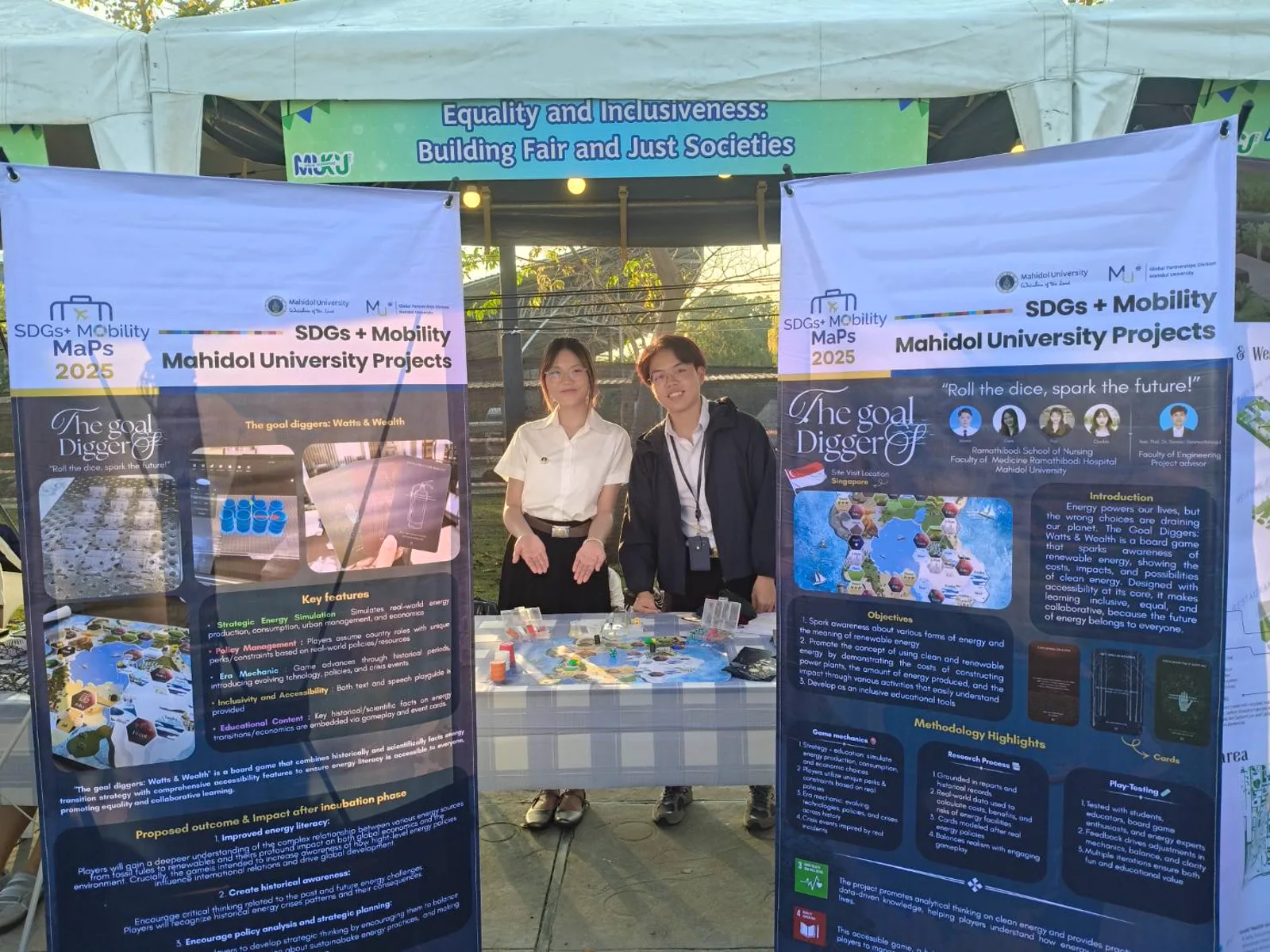
A student-led project on energy transition, climate policy, and the UN Sustainable Development Goals.
Student-led grantee project · SDGs + Mobility MaPs 2025 · Global Partnerships Division, Mahidol University




How we started
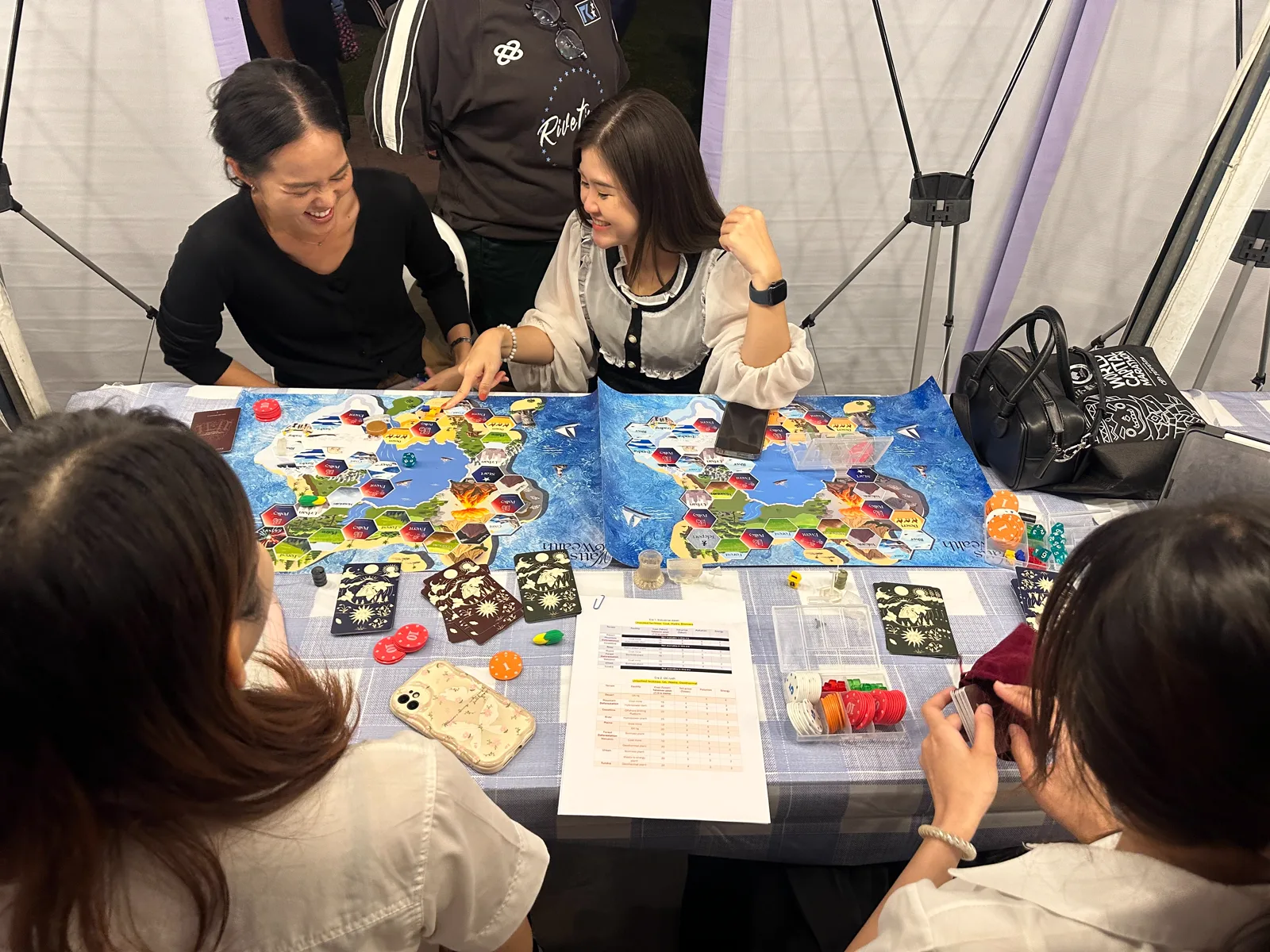
Watts and Wealth began as a class project on the UN Sustainable Development Goals, built as a tabletop board game prototype to make the energy transition feel like a series of choices rather than a chart in a report. The first physical version ran on hand-cut cards, dice borrowed from a Monopoly set, and a printed paper grid taped to a kitchen table.
That first session ran long. Players argued about whether nuclear should count as “clean.” Someone tried to build five coal plants in a row and discovered that a Drought card blocks hydro builds on the very turn they meant to pivot. By the end of round 18 the table had reorganised itself: the loudest pro-coal player was holding back a Climate Adaptation Strategy to gift to the renewable-pathway opponent, because the alternative was losing the whole game to the pollution counter. That moment — the table doing the work the lecture couldn’t — became the design thesis.
Over 22+ iterations the prototype moved from paper to Unity to a browser-based hot-seat edition. The Asia-Pacific lens stayed locked from day one: this is a region carrying the highest climate exposure and the steepest transition curve, and we wanted a game that played the way the region actually negotiates — with subsidy politics, smog crises, and a power grid that still runs on a lot of coal.
The team
Five students of the Faculty of Medicine Ramathibodi Hospital, Mahidol University.
- Thanakrit PhanusophaProject LeadFaculty of Medicine Ramathibodi Hospital, Mahidol University
- Itsaree KittichokthanawatFaculty of Medicine Ramathibodi Hospital, Mahidol University
- Pavitchaya KheedwanFaculty of Medicine Ramathibodi Hospital, Mahidol University
- Rinlada LamlertFaculty of Medicine Ramathibodi Hospital, Mahidol University
- Tanathip SrigrajangFaculty of Medicine Ramathibodi Hospital, Mahidol University
Project advisor
The journey
- R1–R8 Tabletop prototype. Hand-cut cards, dice from a Monopoly set, printed paper grid. Eight playtest sessions on the physical version surfaced the early-coal / mid-game-pivot pattern that still holds in the digital editions.
- R5 Card text immutability locked as a design rule. From this point on, balance changes move through silent constants only — never through rewriting printed card effects.
- R9–R16 Unity 6 hot-seat port. Phase 3 card system implementation. Hot-seat handoff UX iterated to friction-free by R12.
- Snapshot Unity build tagged as final-snapshot reference. The whole game then re-implemented for the browser in TypeScript + React with a deterministic action-log engine.
- R17–R22 Browser hot-seat edition. Setup friction dropped to seconds (no install). Mid-game pivot pattern replicated from earlier phases. Adversarial code review introduced as a default last-step on text-heavy work.
- Now Live at play.wattsandwealth.online. Companion site built alongside for the SDGs + Mobility MaPs 2025 submission.
Acknowledgments
Playtesters across 22+ sessions contributed the trade-off pressure that shaped every card. The full playtester cohort acknowledgment will be published at public release.
- Asst. Prof. Dr. Somsiri Siewwuttanagul — project advisor, Division of Logistics and Rail Engineering, Faculty of Engineering, Mahidol University.
- Global Partnerships Division, Mahidol University — the SDGs + Mobility MaPs 2025 program that incubated the project.
- The open-source community — Astro, Tailwind, React, Vite, and dozens of smaller packages that the web edition stands on.
- Claude (Anthropic) — AI coding collaborator and adversarial fact-checker used as a development tool throughout the build.